
A customer opening your annual report may want to understand your work. A manager may go straight to the financial summary. Your delivery team may need the definitions behind the activity figures. PDF reuse helps you give each group a relevant explanation without rewriting the underlying facts.
The useful changes are specific: lead with a different finding, explain unfamiliar terms, and choose supporting details that help the reader. This PDF reuse guide works through three versions of one annual review, then shows where different publishing formats can carry those versions.
Keep the Source Facts Accurate During PDF Reuse
Before shortening a PDF, mark the information that must remain accurate wherever it appears. A number includes its unit, reporting period, and definition. Removing one of those can change what the reader thinks it means.
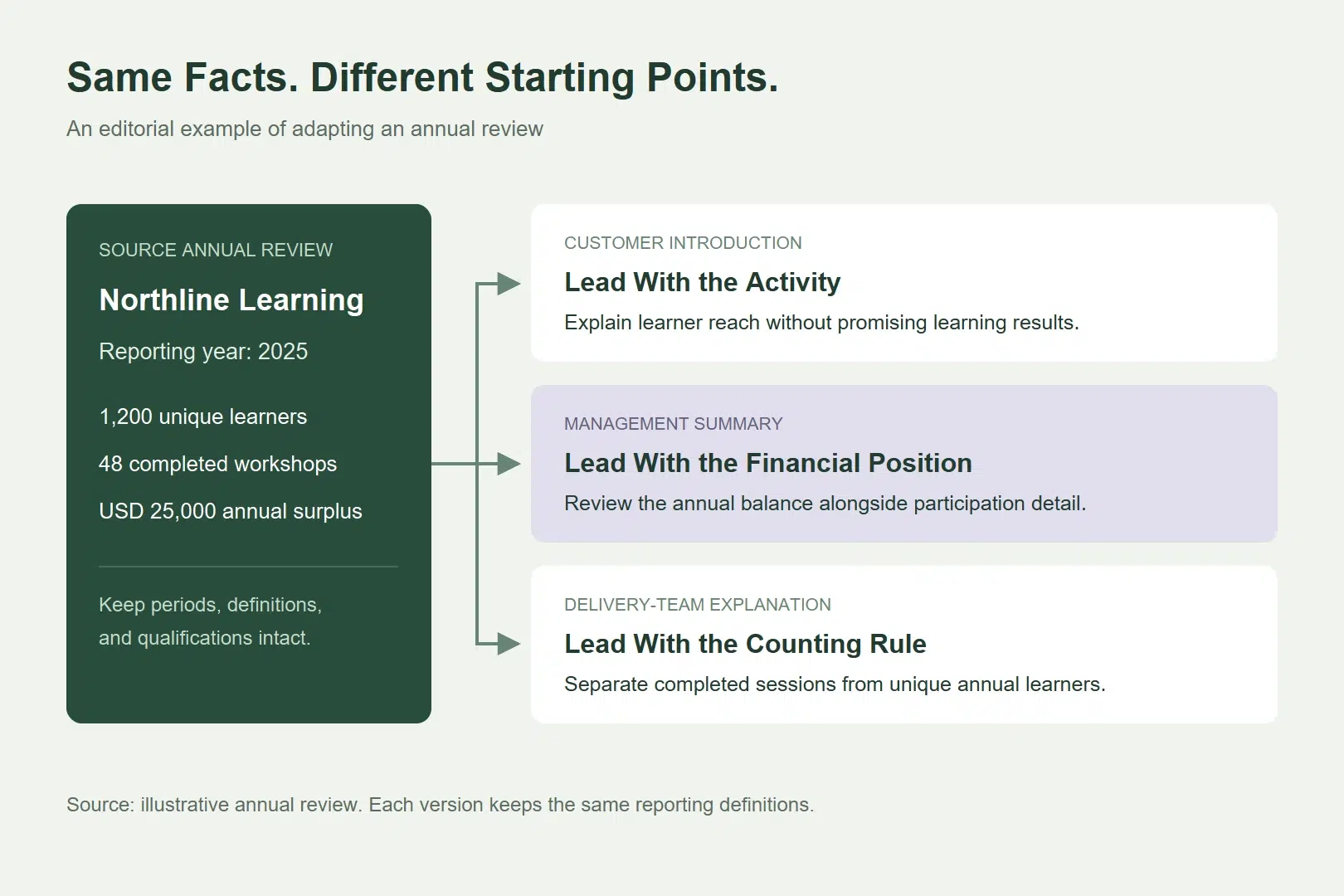
For the worked example, consider a four-page annual review for Northline Learning, an example organization. The source contains these figures and measurement notes:
| Source Detail | Fact to Preserve | Meaning to Keep |
| Participation summary | 1,200 learners reached in 2025 | Unique participants, with each learner counted once during the year |
| Workshop summary | 48 workshops delivered in 2025 | Completed sessions, not future bookings |
| Year comparison | 900 unique learners in 2024 and 1,200 in 2025 | Both years use the same counting definition |
| Measurement note | Reach is not a learning-outcome score | Participation does not establish learning improvement |
| Financial overview | USD 240,000 income, USD 215,000 expenditure, USD 25,000 annual surplus | The reporting year is 2025; these totals do not authorize future spending |
You can change the order and amount of explanation. You cannot turn “unique learners reached” into “learners who improved,” or describe completed workshops as places available to book.
Keep a short source note beside your working copy. For example: “Participation: pages 2–3; finance: page 4; January–December 2025.” That makes it easier to check an adapted paragraph without searching the entire document again.
Rewrite the Opening for Each Audience
The same first paragraph rarely belongs in every version. Start with the information most relevant to that group, then keep enough context to make the statement accurate. Compare how the lead and supporting detail change in these three openings.
Customers: Explain the Scale of the Work
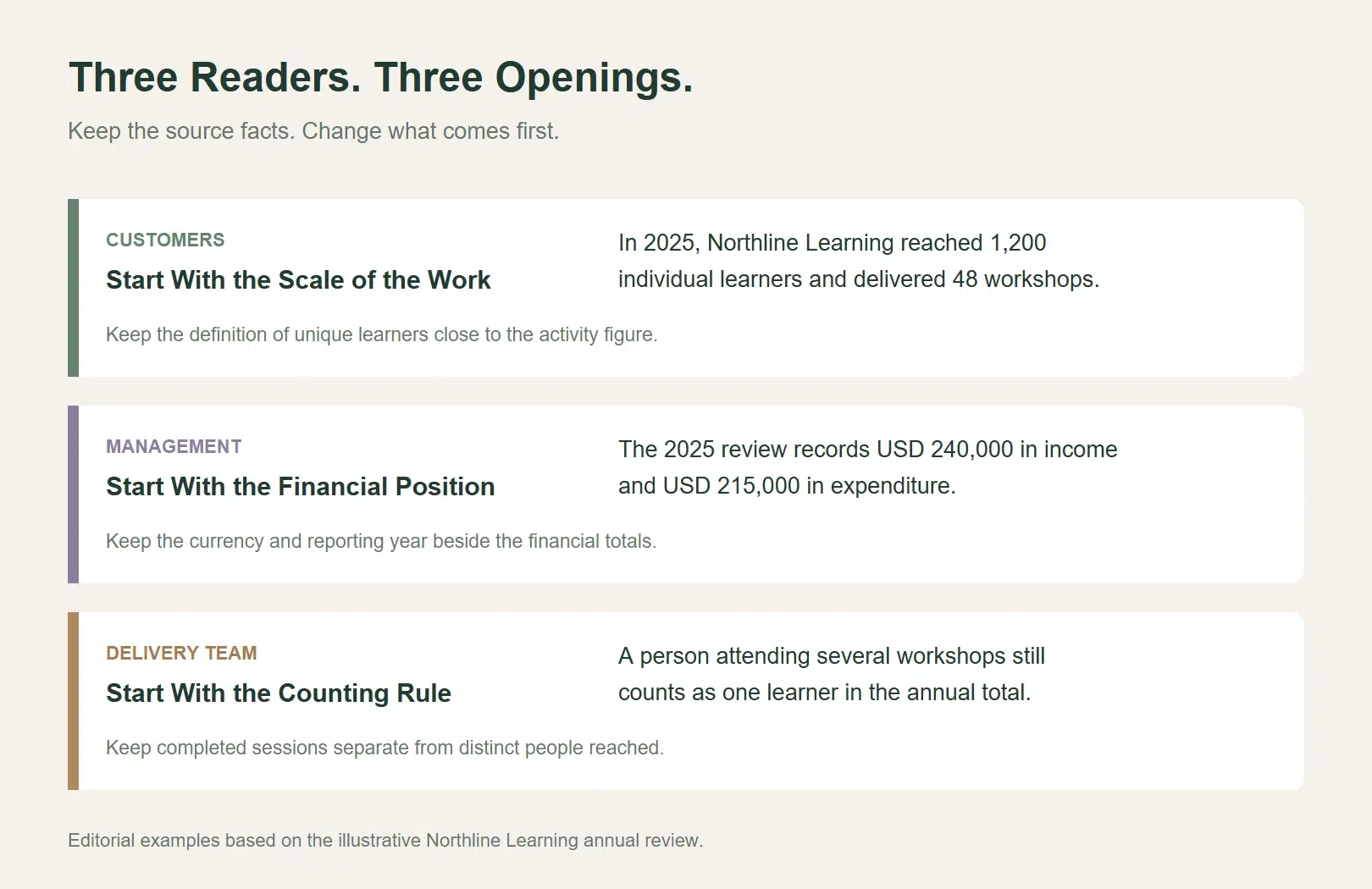
In 2025, Northline Learning reached 1,200 individual learners and delivered 48 workshops. Each learner is counted once, even if they attended more than one session. These figures describe the scale of the year’s activity; the annual review does not use them as a measure of learning improvement.
This version explains “unique” in ordinary language and puts the organization’s activity before its finances. A prospective learner can understand what the numbers describe without needing the income breakdown in the opening paragraph.
The accompanying link should lead to the complete review or its participation detail. If you also want to invite course inquiries, check the current course information separately. An annual activity count does not tell you which courses are open now.
Management: Lead With the Annual Financial Position
Northline Learning recorded USD 240,000 in income and USD 215,000 in expenditure for 2025, leaving an annual surplus of USD 25,000. The same year’s activity totals were 1,200 unique learners reached and 48 completed workshops. Review the participation and financial sections together before discussing the next year’s priorities; the report does not allocate costs or outcomes to individual workshops.
The financial position now comes first. Participation provides context, rather than a claim that the organization achieved a particular return on spending.
For a management discussion, keep the financial detail close to this summary. The source separates program-delivery expenditure from operations, but it does not establish a cost per learner or unrestricted funds available for expansion. Those would need additional information.
Delivery Team: Explain the Counting Rule
The 2025 review records 48 completed workshops and 1,200 unique learners. A person attending several workshops still counts as one learner in the annual total. Keep workshop completion and learner reach separate when comparing delivery records with the review, and retain the January–December reporting period in any team summary.
This version focuses on the definitions behind the totals. It gives the team something concrete to check when preparing a summary: completed sessions are one measure, and distinct people reached are another.
Dividing 1,200 by 48 would not establish an average class size. A unique annual participant count is different from the sum of attendance across individual sessions. Keep that distinction in the team explanation instead of introducing a convenient but unsupported number.
Decide What to Leave Out of Each Version
Leaving out a detail can make a summary easier to use. The important distinction is whether that detail is unnecessary for the task or necessary to interpret a claim you kept.
The customer opening can leave out the grant and donation breakdown because it makes no financial claim. It should keep the definition of learner reach because that qualification explains its main figure. The management version needs the financial period and currency beside the totals, even if you remove the longer program description.
Use these checks when editing:
- If the number remains, keep its period and unit clear.
- If the source qualifies a claim, keep the qualification beside that claim.
- If you remove a supporting section, do not leave a link or sentence promising that it is still included.
- If a detail is essential only to one group, put it in that version rather than expanding every summary.
Write the version’s intended use in one sentence while drafting. For the delivery team, that might be: “Explain how the annual review counts completed workshops and unique learners.” A sentence about funding growth would not belong in that summary unless you intentionally changed its purpose and had evidence to support it.
Match the Explanation to the Publishing Format
A new file format does not, by itself, create a new audience version. The adapted opening and supporting detail still need to appear in the content people read or hear.
A customer-facing webpage can start with the activity summary and link to the full review. A management presentation can put the annual balance before the participation figures. A team handout can keep the measurement definition beside the activity totals.
If you prefer a short video for the team, the narration could explain why repeated attendance does not add another unique learner. The same narration would be less relevant in a brief introduction aimed at prospective customers. Choose the explanation first, then choose a format that can present it clearly.
Prepare the Versions With Recastia
Recastia provides separate workflows for turning PDF material into webpages, videos, browser presentations, and flipbooks. Prepare the wording for each group first, then use the relevant editor to build its version.
For a customer-facing landing page, edit the introduction and its links to supporting information. Lead with the participation explanation, then give readers a clear route to the full review. Keep the financial discussion elsewhere if it is not part of that page’s purpose.
For a video explanation, the PDF to Video workflow supports page-specific narration. The team version can explain the counting rule beside the participation page. Changing the narrator’s voice alone does not create this adaptation; the script needs the relevant explanation.
For a management meeting, PDF to Presentation creates a browser presentation from document pages. Prepare an audience-specific source PDF when the slides themselves need a different introduction or page order. Do not expect a different presentation setting to rewrite the words printed on those pages.
Use PDF to Flipbook when the complete annual review should remain available as a browsable publication. If you need different wording inside its pages, revise the source document before creating that version. Flipbook appearance settings and an audience-specific rewrite solve different problems.
For the broader choice of outputs, see the Recastia PDF repurposing tool guide.
Catch Meaning Changes Before You Share
Read each adapted statement beside the source, rather than checking only whether the numbers match. A summary can repeat the correct number and still make the wrong claim.
| Adapted Wording That Goes Too Far | Why It Changes the Meaning | Source-Faithful Wording |
| 1,200 learners improved their skills | The source counts participation, not learning improvement | Northline reached 1,200 unique learners in 2025 |
| The USD 25,000 surplus can fund expansion | An annual surplus does not establish approved spending or available unrestricted funds | The review records a USD 25,000 annual surplus for 2025 |
| Workshops averaged 25 learners each | Unique annual learners and session attendance are different counts | The review records 48 completed workshops and 1,200 unique learners |
Finish by checking the next action. A public reader may need more context, management may need to review supporting detail, and the delivery team may need to compare definitions with its records. Keep each invitation within what the document actually supports.
Frequently Asked Questions
Start with a shared summary, then separate the detail by topic. In this example, everyone can see the year and headline activity totals before management reviews the financial section. Keep the fuller definitions available so a short opening does not become the only explanation of the figures.
Translation addresses language. Audience adaptation also changes which information comes first and how much background you explain. Two groups using the same language may need different versions, while a translated version may keep the same purpose and content order as the original.
Yes, when that audience is allowed to see the complete document. Label the full version clearly and link to the relevant detail where possible. If the source contains confidential sections, prepare an approved shareable version first; a short introduction does not make the attached source less sensitive.
Explain the term when it first matters. “Each learner is counted once during the year” is clearer for a general reader than leaving “unique participants” unexplained. Keep any definition that affects interpretation, even when a specialist audience needs less background elsewhere in the summary.
Conclusion
PDF reuse lets you change the lead, supporting detail, and next action while keeping the source facts intact. The customer, management, and delivery-team examples use the same annual review but give each group a different, specific explanation.
Start your next PDF reuse task with one document and one group. Draft its opening, check every claim against the source, and then choose the format that will carry that explanation.
Bring Your PDF to Life With Recastia
Create, customize, and share your content in a more engaging way.