
A knowledge transfer document should let someone run the next cycle without asking the outgoing owner to explain every line. Start with what the new owner has to deliver. Then add the decisions that change the plan, the exceptions they’re likely to face, and the work they’ll inherit on day one.
Take a monthly publishing handover. The notes may say a partner logo was dropped last time, but the incoming editor needs to know when to make that call and where to find the approved replacement. This example shows how to turn notes like that into a knowledge transfer document. Once the guide is ready, you can use Recastia to share it as a browsable flipbook with page numbers the team can refer to together.
Start With the Next Release
Write the first page for the person taking over the calendar. Give them a starting point and a way to tell when the work is ready to move on. In the sample guide, the incoming managing editor confirms the article list with the campaign lead five working days before release. The assigning editor then sends the copy and its sources to the product reviewer. Name who checks the destination links and the date against the calendar after scheduling. A reminder to “check before launch” is easy to miss when everyone thinks someone else owns it.
Put timing next to the action it affects. Keep the full editorial calendar where the team already maintains it. The handover only needs to point the incoming owner to the right place and tell them which dates matter.
Turn Past Fixes Into Rules Someone Can Use
Scan the notes for moments when the team changed course. Write down what triggered the change, what the team did, and why. If the old owner has moved on, a short explanation helps the new one tell which parts of the process can change safely.
| What the Notes Say | What the Incoming Editor Needs |
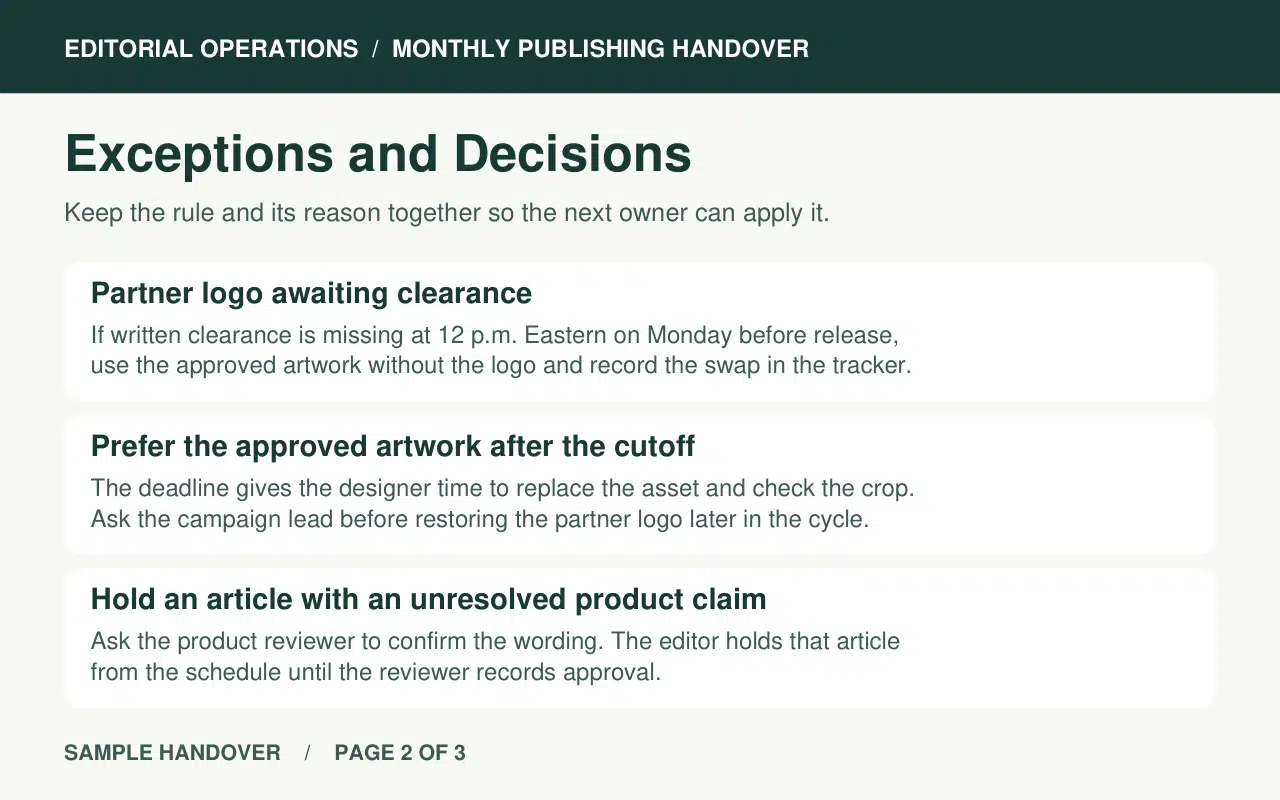
| “Dropped partner logo last time.” | If written clearance is missing at noon Eastern on the Monday before release, use the approved artwork without the logo. Record the swap in the release tracker. The cutoff gives the designer time to replace the asset and check the crop. |
| “Product claim held up scheduling.” | Hold the affected article until the product reviewer records approval. The assigning editor sends the reviewer the claim and its source so they can check the proposed wording. |
| “Still waiting on the partner team.” | The incoming managing editor checks for written clearance before Monday at noon Eastern. Until then, the release tracker should show the item as open. |
The first two entries are rules the next editor can reuse. The last one belongs in the handover because it’s still open. Keep its current status in the tracker so the team can update it when a reply comes in.
Share the Guide as a Flipbook With Recastia
As anotações já contêm as informações necessárias para sua equipe. Depois de digitá-las, o Recastia facilita a navegação no PDF final. Mantenha as aprovações confidenciais e os materiais não publicados nos sistemas que sua equipe já utiliza. Use uma versão aprovada do guia ao criar o flipbook.
- Exporte o Guia de Entrega como um PDF
Coloque a próxima versão na página um, as regras e exceções na página dois e os itens em aberto na página três. Dê a cada página um título e um número. Alguém que se lembre da regra do logotipo da reunião de transição poderá encontrá-la novamente sem precisar ler todo o guia.
- Abra o PDF no Flipbook Maker.
Upload the finished PDF to Criador de Flipbooks. Sign in if Recastia prompts you to continue. Once the reader is ready, turn through to the last page. Use the page controls to go back to the exception page, then check that the deadline, replacement artwork, and decision owner are legible. If any detail is unclear, fix it in the source PDF before sharing.
- Compartilhe o guia com um ponto de partida.
Se um link do navegador estiver de acordo com as regras de compartilhamento da sua equipe, abra a opção Compartilhar para copiar o link de leitura. Indique ao novo editor a página dois e pergunte qual ilustração ele usaria caso o prazo final seja ultrapassado sem autorização por escrito. Peça a ele que abra o guia no dispositivo que usará para a publicação e encontre a regra.
Run One Handover Rehearsal
Give the incoming editor ten minutes with the guide and the tracker. Ask them to find the artwork, explain the fallback, and point to where they’ll record the decision. Then give them a second scenario. The logo is cleared, but one article still has an unapproved product claim. What stays on hold?
Listen for the distinction. The team can replace the logo under the standing rule, while the affected article stays out of the schedule until the claim is approved. If the editor can explain both decisions and find the records, they have enough context to run the next cycle. If they have to ask where something lives, add that location to the guide while you’re both there.
Perguntas frequentes
Peça ao proprietário atual para elaborar os passos e as decisões, e depois dê ao novo proprietário uma tarefa real para testar. Ele identificará acessos ausentes, nomes desconhecidos e etapas que todos os outros consideram óbvias. Peça a um terceiro membro da equipe para revisar quaisquer regras de aprovação ou escalonamento sob sua responsabilidade.
Anote a regra que a equipe usará na próxima versão e quem pode alterá-la. Adicione uma data de revisão e um link para a discussão para quem precisar do contexto. Se não houver uma regra acordada, registre a decisão como em aberto e indique a pessoa responsável por resolvê-la.
Liste o espaço de trabalho ou pasta de que precisam, o nível de permissão e a função que pode concedê-la. Solicite o acesso antes do ensaio. Não inclua detalhes de login e credenciais no guia.
Atualize o PDF e sua cópia de leitura sempre que uma regra de decisão for alterada, uma responsabilidade for transferida ou um link deixar de funcionar corretamente. Utilize o rastreador para acompanhar as alterações diárias de status. Inclua a data da revisão no guia para que o novo responsável possa identificar qual edição está lendo.
Conclusão
Build the knowledge transfer document around the next release. Keep deadlines beside the decisions they govern, and give every unresolved item an owner and a next action.
Before you hand over the knowledge transfer document, ask the new owner to try one decision with the guide open. A browsable copy makes the right page easy to find. Their answer tells you what the page still needs.
Dê vida aos seus PDFs com Recastia.
Crie, personalize e compartilhe seu conteúdo de uma forma mais envolvente.